
Press & Reviews
ALEXANDER THE GREAT
Alexander the Great, by Natasha Fraser-Cavassoni
PARIS — Once upon a time, there was an art-world legend named Alexander Iolas. Born in Alexandria, Egypt, the art dealer's passion was great, daring, and rooted in poetry. Driving through moonlit Athens, he believed he was in Ancient Greece. "I can see the gods, I can see the gods," he would exclaim in rapture. You can still see Iolas even 35 years after his death, in June 1987. He is there in Netflix's The Andy Warhol Diaries; his work is documented in a biography by his niece, Eleni Koutsoudi-Iola; and he was the haunting presence behind the auction of the André Mourgues Collection — Alexander Iolas and His Artists at Sotheby's in Paris in March 2022.
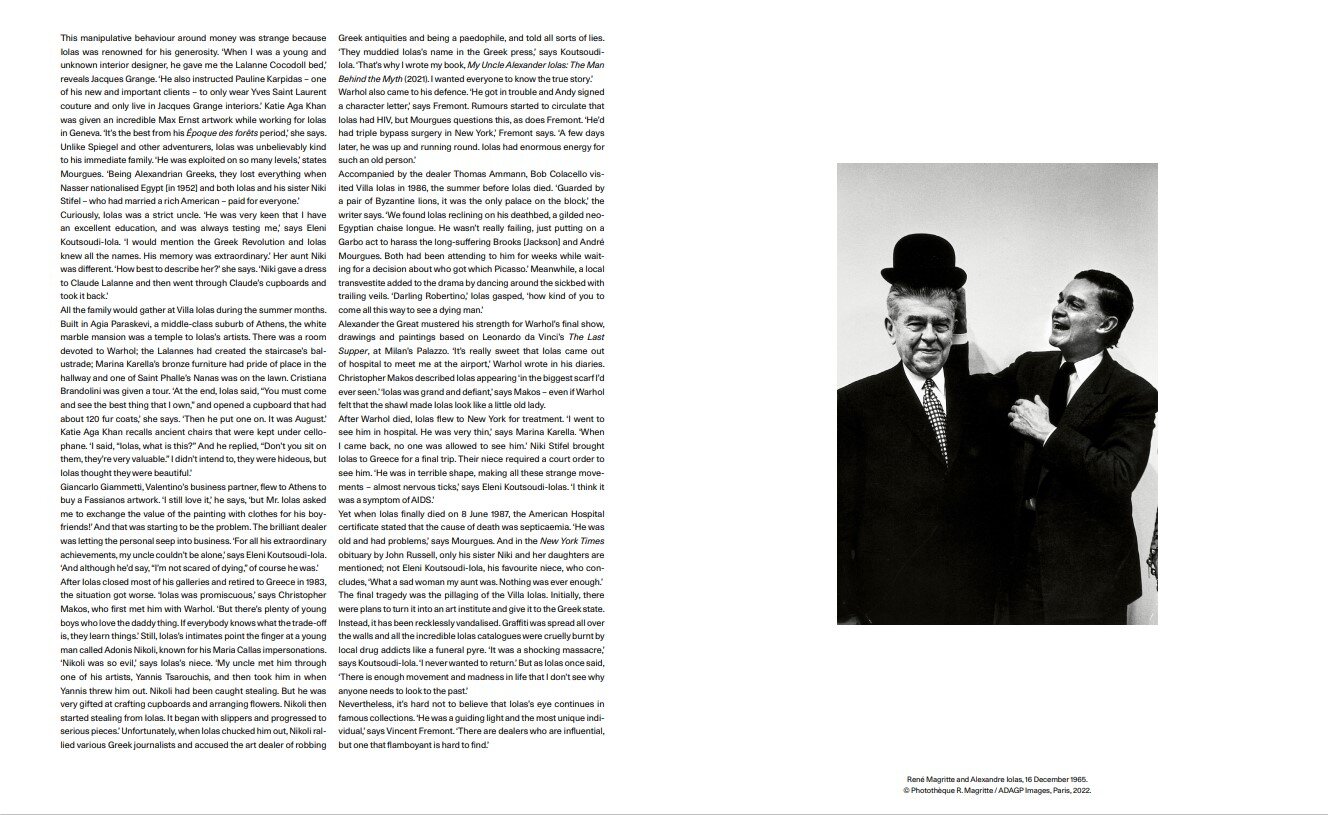
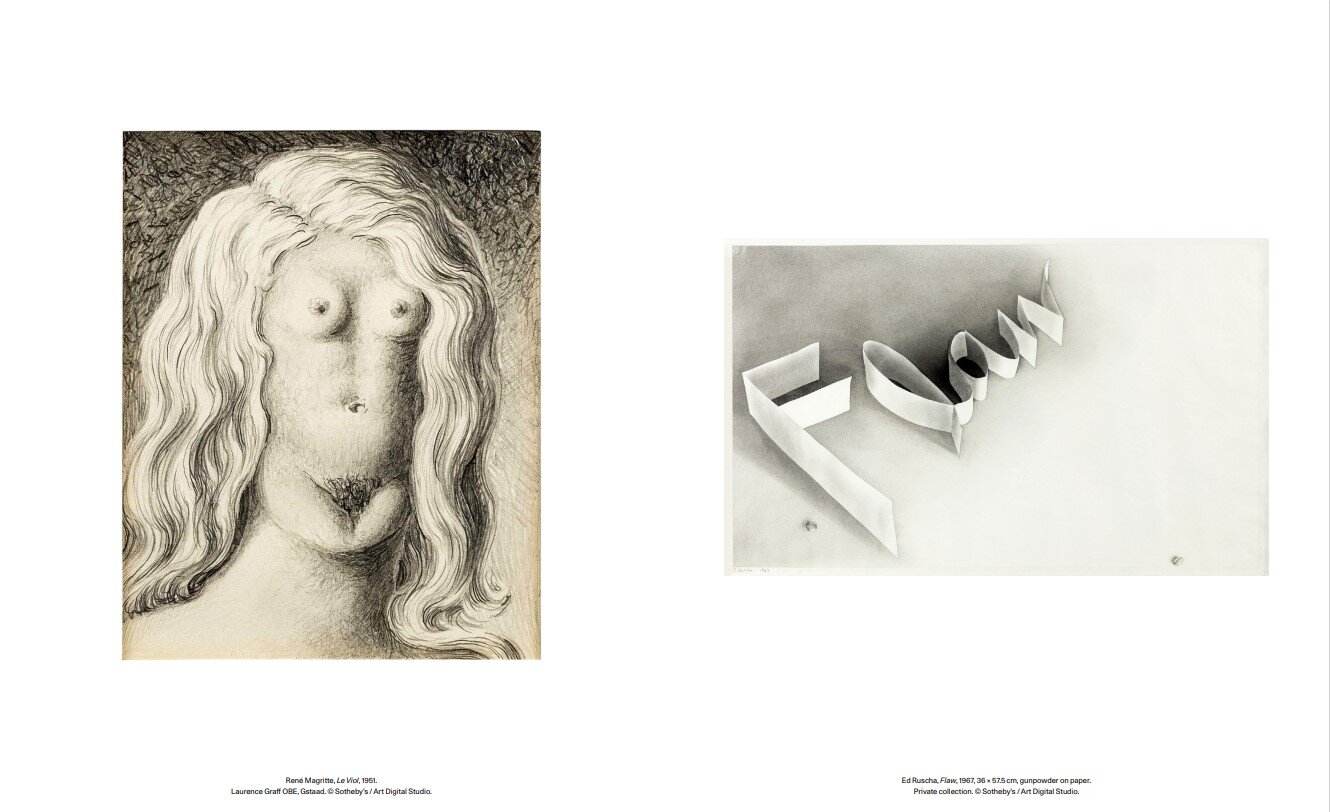
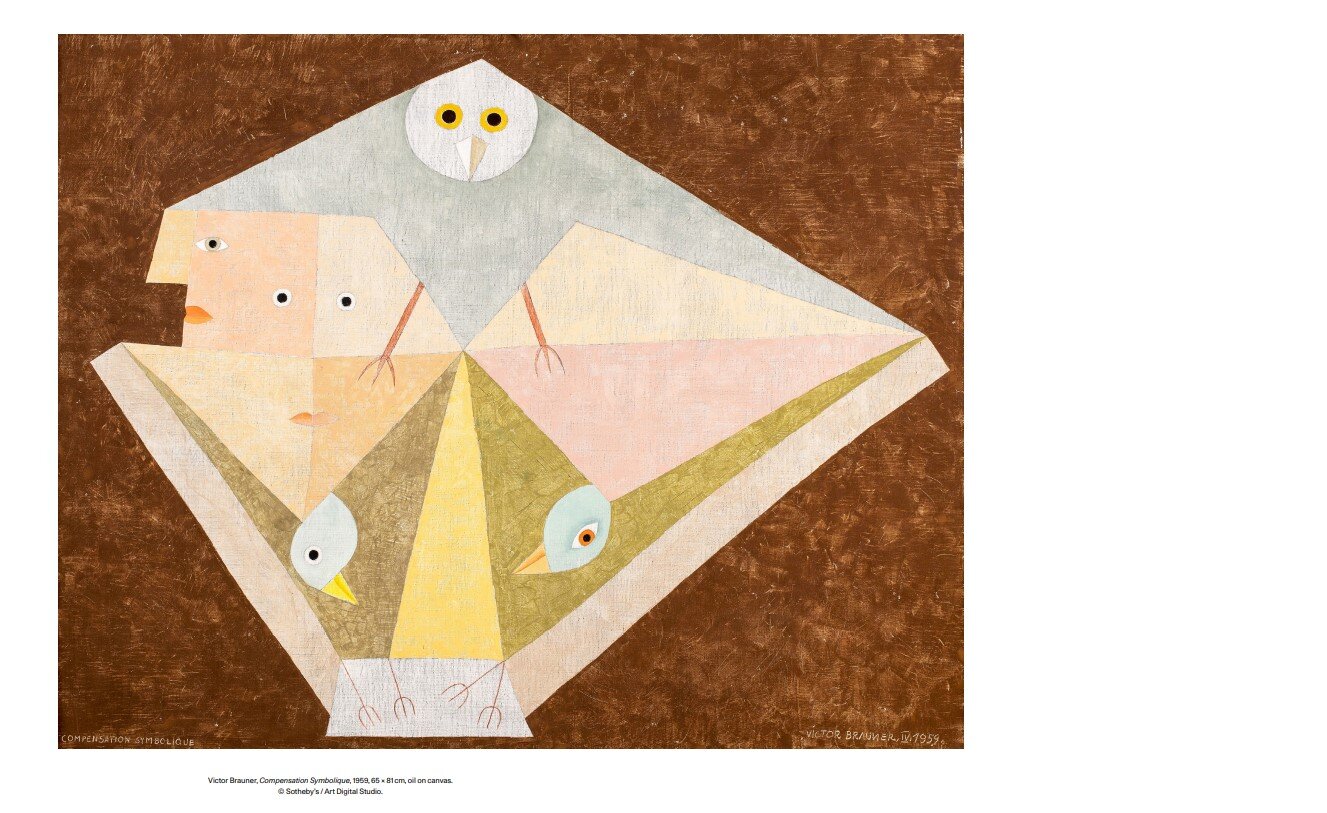
Walking into Sotheby's sale rooms becomes otherworldly. It is the power of Iolas's choices and the tender thoughtfulness accompanying each piece — whether Max Ernst's bronze La Plus Belle, Victor Brauner's Compensation Symbolique, Magritte's Le Viol, or a spectacular Egyptian antiquity, a granite lion's head. Iolas's eye and his energy are omnipresent; it is almost as if he is there, guiding you around. According to Mourgues, Iolas's lifelong companion from 1962 onward, that was what mattered most. "The artists were his family, and the gallery was his home," says the Parisian.
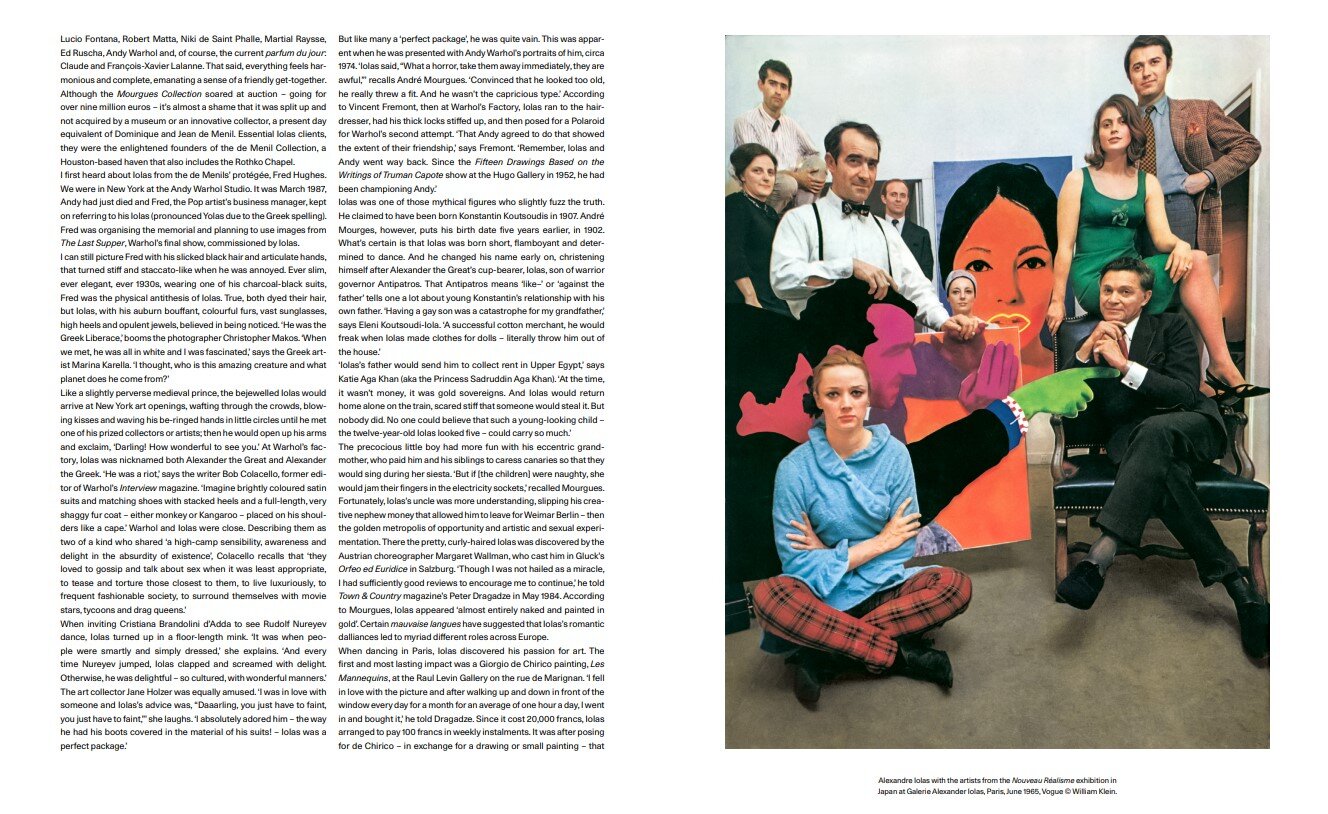
Since Iolas was the great champion of the avant-garde in the twentieth century, the inspired list of aforementioned surrealists sits alongside works by William Copley, Alekos Fassianos, Lucio Fontana, Robert Matta, Niki de Saint Phalle, Martial Raysse, Ed Ruscha, Andy Warhol and, of course, the current trend: Claude and François-Xavier Lalanne. Everything, however, exudes a sense of harmony and completeness, creating an atmosphere of friendly gathering. Although the Mourgues Collection soared at auction — for more than nine million euros — it is almost a shame that it was broken up rather than acquired by a museum or a visionary collector, some present-day equivalent of Dominique and Jean de Menil. Vital clients for Iolas, the de Menils were the enlightened founders of the Houston-based Menil Collection, which also includes the Rothko Chapel.
I first heard about Iolas from the de Menils' protégé, Fred Hughes. We were in New York, at the Andy Warhol Studio. It was March 1987, Andy had just died, and Fred, the pop artist's business manager, kept referring to his Iolas. Fred was organising a memorial and planned to use images from The Last Supper, Warhol's final show, commissioned by Iolas. I can still see Fred with his glossy black hair and his eloquent hands, which would grow stiff and snap sharply when something annoyed him. Always slim, always elegant, always thirties in one of his charcoal-black suits, Fred was the opposite of Iolas. True, both dyed their hair, but Iolas — with his auburn bouffant, colourful furs, oversized sunglasses, high heels and lavish jewellery — believed in being noticed. "He was the Greek Liberace," echoes photographer Christopher Makos. "When we met, he was dressed all in white and I was enchanted," says the Greek artist Marina Karella. "I thought, who is this incredible creature and from what planet does he come?"
Like a slightly wayward medieval prince, the adorned Iolas would arrive at New York art openings, cutting through crowds unhindered, throwing air kisses, and greeting people with his ring-covered hands drawing tiny circles, until he came upon one of his prized collectors or artists; then he would open his arms and cry out, "My love! How happy I am to see you." At Warhol's Factory, Iolas acquired two nicknames: Alexander the Great, and Alexander the Greek. "It was a revelation," says the writer Bob Colacello, former editor of Warhol's Interview magazine. "Imagine satin suits in vivid colours and matching platform heels, and a long, thick-pelted fur — either monkey or kangaroo — draped over his shoulders like a cape." Warhol and Iolas were close. Describing them as two of a kind, sharing "a heightened sensibility, an awareness and delight in the absurdity of existence," Colacello remembers that "they loved to gossip and talk about sex at the most inappropriate moments, to tease and torment those closest to them, to live lavishly, mingle with the crème de la crème, and surround themselves with movie stars, tycoons and drag queens."
When he invited Christiana Brandolini d'Adda to see Rudolf Nureyev dance, Iolas turned up in a floor-length mink. "People dressed elegantly and simply back then," she explains. "And every time Nureyev leapt, Iolas shrieked with pleasure. Beyond that, he was delightful — so cultured, with wonderful manners." The art collector Jane Holzer enjoyed him just as much. "I was in love with someone, and Iolas's advice was, 'Daaarling, you must simply faint, you must simply faint,'" she says, laughing. "I absolutely adored him — the way he covered his boots with the fabric of his suits! — Iolas was the perfect package." But like many "perfect packages," he was rather vain. This became clear when he was presented with the portraits Andy Warhol had made of him in 1974: "Iolas said, 'How horrible, take them away at once, they are dreadful,'" recalls André Mourgues.
"He was convinced he looked far too old, he really had a fit. And he was not an unpredictable man."
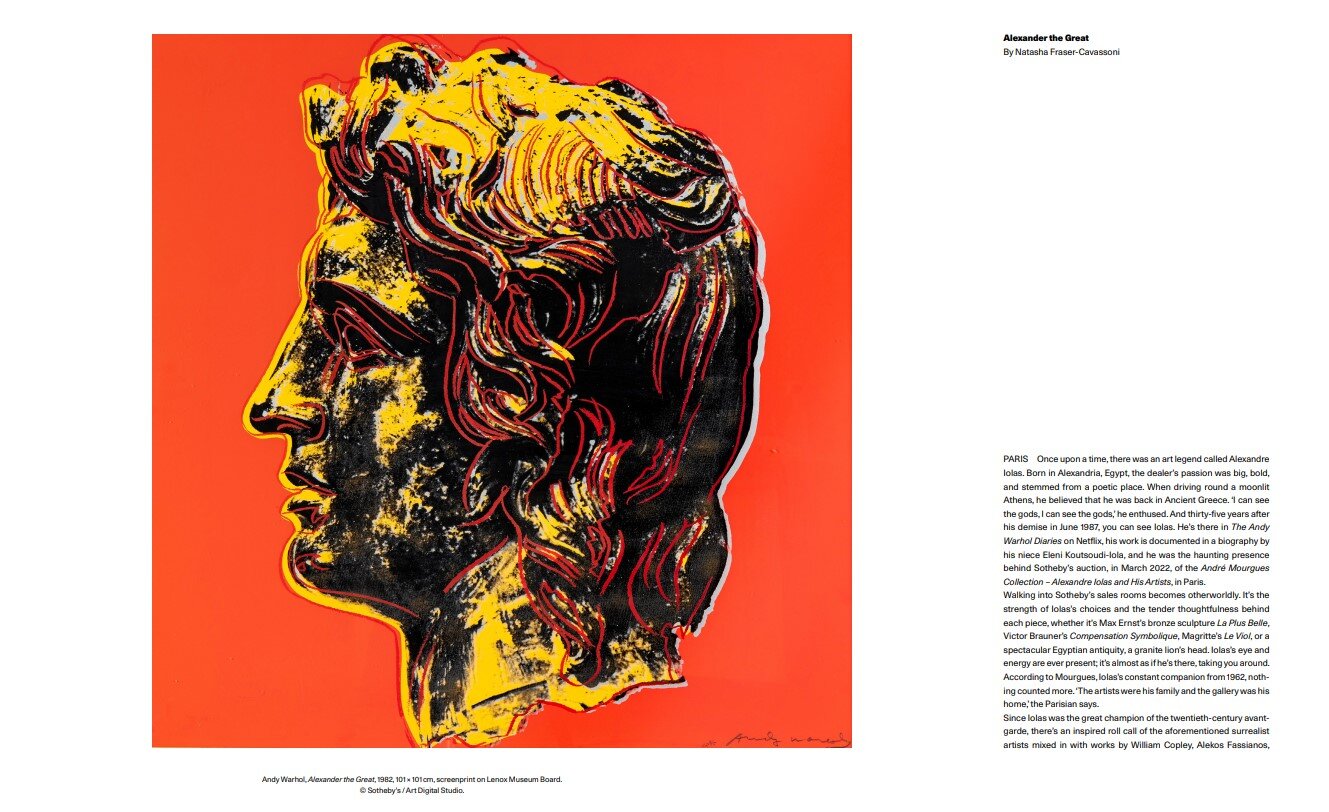
According to Vincent Fremont, back at Warhol's Factory, Iolas rushed off to the hairdresser, arranged his lush mane, then posed for Polaroids for Warhol's second attempt. "The fact that Andy agreed to do it shows the depth of their friendship," says Fremont. "Remember, Iolas and Andy have a history. He supported Andy from the show Fifteen Drawings Based on the Writings of Truman Capote at the Hugo Gallery in 1952."
Iolas was one of those mythical figures who slightly blurred the truth. He claimed to have been born in 1907 as Constantinos Coutsoudis. André Mourgues, however, places his birth date five years earlier, in 1902. What is certain is that Iolas was born short, sparkling, and determined to dance. He changed his name early, christening himself Iolas after Alexander the Great's cupbearer, son of the warrior and regent Antipater. The fact that Antipater means "like" or "against the father" says a lot about young Constantinos's relationship with his own father. "Having a gay son was a disaster for my grandfather," says Eleni Koutsoudi-Iola. "He was a successful cotton merchant, and it drove him wild when Iolas made clothes for dolls — he would literally throw him out of the house." "His father would send him to collect the rent in Upper Egypt," says Katie Aga Khan (also known as Princess Sadruddin Aga Khan). "At that time, there was no cash, there were gold sovereigns. And Iolas would come home alone by train, stiff with fear that someone would rob him. But no one did. No one could believe that such a small boy — twelve-year-old Iolas looked five — could ever be carrying such sums." The precocious little boy was more amused, though, by his eccentric grandmother, who paid him and his siblings to stroke the canaries so they would sing during her siesta. "But if [the children] were naughty, she would stick their fingers into the electric sockets," Mourgues remembers. Fortunately, Iolas's uncle was more understanding, secretly giving money to his creative nephew, which allowed him to leave for Weimar Berlin — then the golden metropolis of opportunities and artistic and sexual experimentation. There, the beautiful, curly-haired Iolas was discovered by the Austrian choreographer Margaret Wallmann, who gave him a role in Gluck's Orfeo ed Euridice in Salzburg. "Although I was not hailed as a marvel, I received good enough reviews to encourage me to continue," he told Peter Dragadze of Town & Country magazine in May 1984. According to Mourgues, Iolas appeared "almost completely naked and painted gold." Some malicious tongues have hinted that Iolas's romantic adventures led to myriad different roles all over Europe.
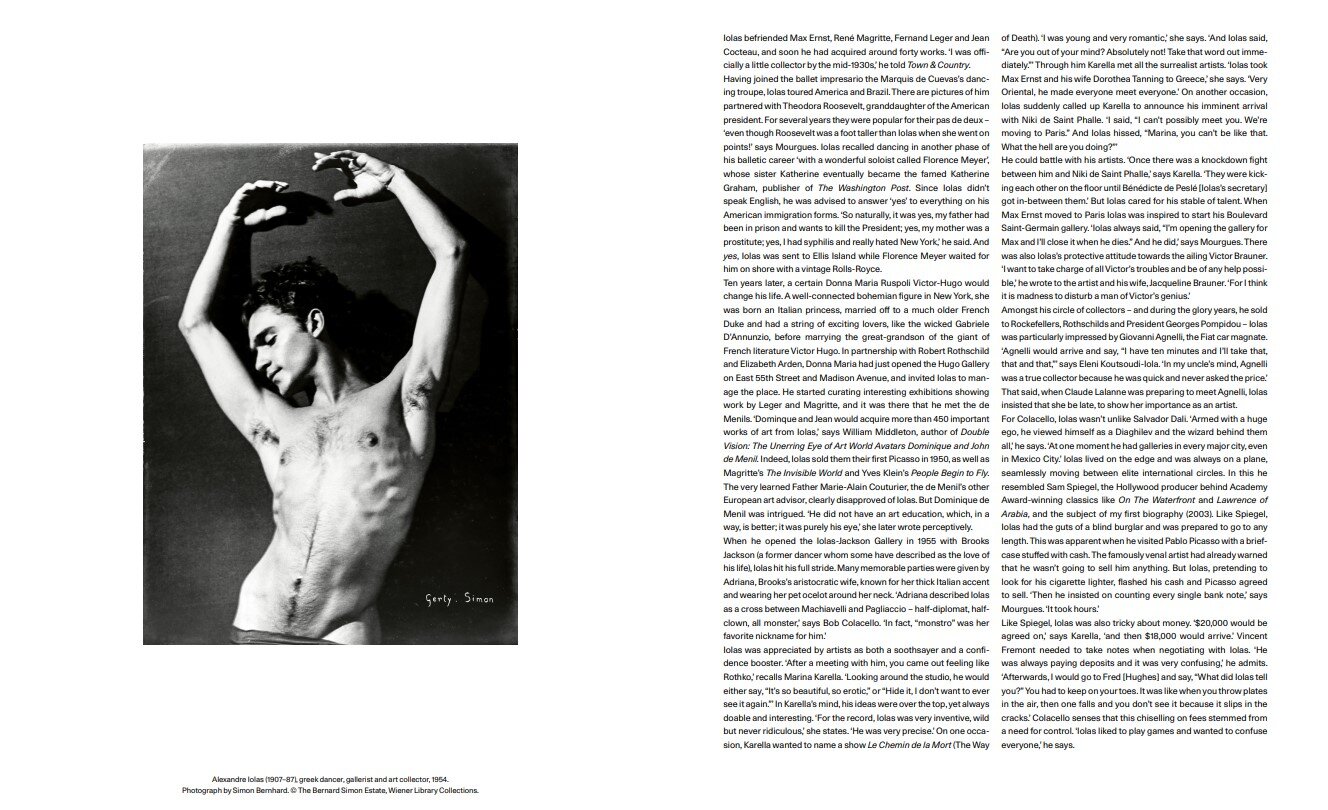
While dancing in Paris, Iolas discovered his passion for art. The first and most lasting influence on him was Giorgio de Chirico's painting Les Mannequins in the Galerie Raul Levin, on Rue Marignan. "I fell in love with that painting, and after pacing up and down in front of the window for about an hour a day, every day, for a month, I went in and bought it," he told Dragadze. It cost 20,000 francs, and Iolas arranged to pay 100 francs in weekly instalments. After posing for de Chirico — in exchange for a drawing or small painting — Iolas became friends with Max Ernst, René Magritte, Fernand Léger and Jean Cocteau, and soon acquired about forty works. "I was officially a small collector in the mid-1930s," he told Town & Country.
As a member of the Marquis de Cuevas's ballet company, Iolas toured America and Brazil. There are photographs of him partnered with Theodora Roosevelt, granddaughter of the American President. For several years they were popular thanks to their pas de deux — "even though Roosevelt was a foot taller than Iolas when she rose on pointe!" says Mourgues. Iolas remembered dancing at another stage of his ballet career "with a marvellous soloist named Florence Meyer," whose sister, Katherine, eventually became the famous Katherine Graham, publisher of The Washington Post. Because Iolas did not speak English, he was told to answer "yes" to everything on the American immigration forms. "So, of course: yes, my father was in prison and wanted to kill the President; yes, my mother was a prostitute; yes, I had syphilis and I really hated New York," he said. And yes, they sent Iolas to Ellis Island while Florence Meyer waited for him on the shore in an old Rolls-Royce. Ten years later, a woman named Donna Maria Ruspoli Victor-Hugo would change his life. A bohemian figure with New York connections, she was born an Italian princess, married a much older French Duke, and had a string of exciting lovers, including the sinister Gabriele D'Annunzio, before marrying the great-grandson of the giant of French literature, Victor Hugo. Together with Robert Rothschild and Elizabeth Arden, Donna Maria had just opened the Hugo Gallery at the corner of East 55th Street and Madison Avenue, and offered Iolas the directorship. He began curating interesting exhibitions featuring works by Léger and Magritte, and there he met the de Menils. "Dominique and Jean would acquire more than 450 important works of art through Iolas," says William Middleton, author of Double Vision: The Unerring Eye of Art World Avatars Dominique and John de Menil. Indeed, Iolas sold them their first Picasso in 1950, as well as Magritte's Le Monde Invisible and Yves Klein's People Begin to Fly. The polymath Father Marie-Alain Couturier, the de Menils' other European art adviser, clearly disapproved of Iolas. But he had piqued Dominique de Menil's interest.
"He had no artistic training, which, in a way, is better. It was purely the eye he had," she later wrote perceptively.
When he opened the Iolas-Jackson Gallery in 1955 with Brooks Jackson (a former dancer whom some have described as the love of his life), Iolas reached the top. Many memorable parties were thrown by Adriana, Brooks's aristocratic wife, known for her heavy Italian accent and for wearing her pet ocelot around her neck. "Adriana described Iolas as a hybrid of Machiavelli and Pagliaccio — half diplomat, half clown, a monster," says Bob Colacello. "Indeed, her favourite nickname for him was 'monstro.'"
Artists valued Iolas as a prophet as well as a supplier of their self-confidence. "After meeting with him, you felt like Rothko," remembers Marina Karella. "Looking around the studio, he would either say, 'It is so beautiful, so erotic,' or 'Hide it, I don't want to see it again.'" For Karella, his ideas were extreme, but always attainable and interesting. "Let it be noted in the record that Iolas was very inventive, free, but never ridiculous," she says. "He was very precise." Once, Karella wanted to name a show Le Chemin de la Mort (The Path of Death). "I was young and very romantic," she says. "And Iolas said: 'Are you crazy? Certainly not! Get rid of that word at once.'" Through him, Karella met all the surrealist artists. "Iolas brought Max Ernst and his wife, Dorothea Tanning, to Greece," she says. "Very oriental, he made sure everyone met everyone." On another occasion, Iolas suddenly called Karella to announce his imminent arrival with Niki de Saint Phalle. "I said, 'It's impossible for me to meet you. We're moving to Paris.' And Iolas whispered threateningly:"
"'Marina, you can't be like this. What the hell are you doing?'"
He could brawl with his artists. "Once he had a knock-down fight with Niki de Saint Phalle," says Karella. "They kicked each other on the floor until Bénédicte de Peslé [Iolas's secretary] stepped between them." But Iolas cared about the composition of his roster of talents. When Max Ernst moved to Paris, Iolas mobilised to open his gallery on Boulevard Saint-Germain. "Iolas always said: 'I'm opening the gallery for Max and I'll close it when he dies.' And he did," says Mourgues. There was also Iolas's protective attitude toward the ailing Victor Brauner. "I want to take on all of Victor's difficulties and help in every possible way," he wrote to the artist and his wife, Jacqueline Brauner. "Because I think it's madness for a man as brilliant as Victor to be in difficulty."
Among his circle of collectors — and though in his heyday he sold to the Rockefellers, the Rothschilds and President Georges Pompidou — Iolas was particularly impressed by Giovanni Agnelli, the Fiat automotive magnate. "Agnelli would come and say, 'I have ten minutes and I'll take that, that and that,'" says Eleni Koutsoudi-Iola. "In my uncle's mind, Agnelli was a real collector because he was fast and never asked for prices." And yet, when Claude Lalanne was about to meet Agnelli, Iolas insisted she arrive late, to underline her importance as an artist. For Colacello, Iolas was not far from Salvador Dalí. "Armed with a huge ego, he saw himself as another Diaghilev, as the miracle worker behind each one of them," he says. "At one point he had galleries in every major city, even in Mexico City." Iolas lived to extremes and was always on a plane, moving restlessly between circles of the international elite. In this he resembled Sam Spiegel, the subject of my first biography (2003), the Hollywood producer behind Oscar-winning classics like On the Waterfront and Lawrence of Arabia. Like Spiegel, Iolas had the nerve of a blind burglar and was ready to do anything. This became obvious when he visited Pablo Picasso with a briefcase full of cash. The notoriously money-loving artist had already warned that he would sell him nothing. But Iolas, pretending to search for his lighter, briefly let the cash show, and Picasso agreed to sell. "Then he insisted on counting every single banknote," says Mourgues. "It took hours." Like Spiegel, Iolas was also cunning with money. "We would agree on 20,000 dollars," says Karella, "and 18,000 would arrive here." Vincent Fremont had to take notes when negotiating with Iolas. "He always paid deposits and it was very complicated," he admits. "Then I would go to Fred [Hughes] and say, 'What did Iolas tell you?' You had to stay alert. It was like juggling plates — one falls and you don't see it because it slips through the cracks." Colacello senses this appropriation of money came from a need for control. "He liked to play games; Iolas wanted to confuse everyone," he says. This manipulative behaviour about money was strange because Iolas was known for his generosity. "When I was a young and unknown interior designer, he gave me the Lalanne Cocodoll bed," reveals Jacques Grange. "He also gave instructions to Pauline Karpidas — one of his new and important clients — to wear only Yves Saint Laurent and live only in Jacques Grange interiors." An incredible work by Max Ernst was given to Katie Aga Khan while she was working for Iolas in Geneva. "It is the best from his Époque des forêts period," she says. Unlike Spiegel and other notable men, Iolas behaved incredibly well toward his immediate family. "They took advantage of him on many levels," declares Mourgues.
"Being Greeks from Alexandria, they lost everything when Nasser nationalised Egypt [in 1952], and both Iolas and his sister, Niki Stifel — who had married a wealthy American — paid for them all."
Curiously, Iolas was a strict uncle. "He wanted me to have an excellent education, and he was always testing me," says Eleni Koutsoudi-Iola. "I mentioned the Greek Revolution and Iolas knew all the names. His memory was outstanding." Her aunt, Niki, was different. "How can I best describe her?" she says. "Niki gave a dress to Claude Lalanne and then went through her wardrobe and took it back."
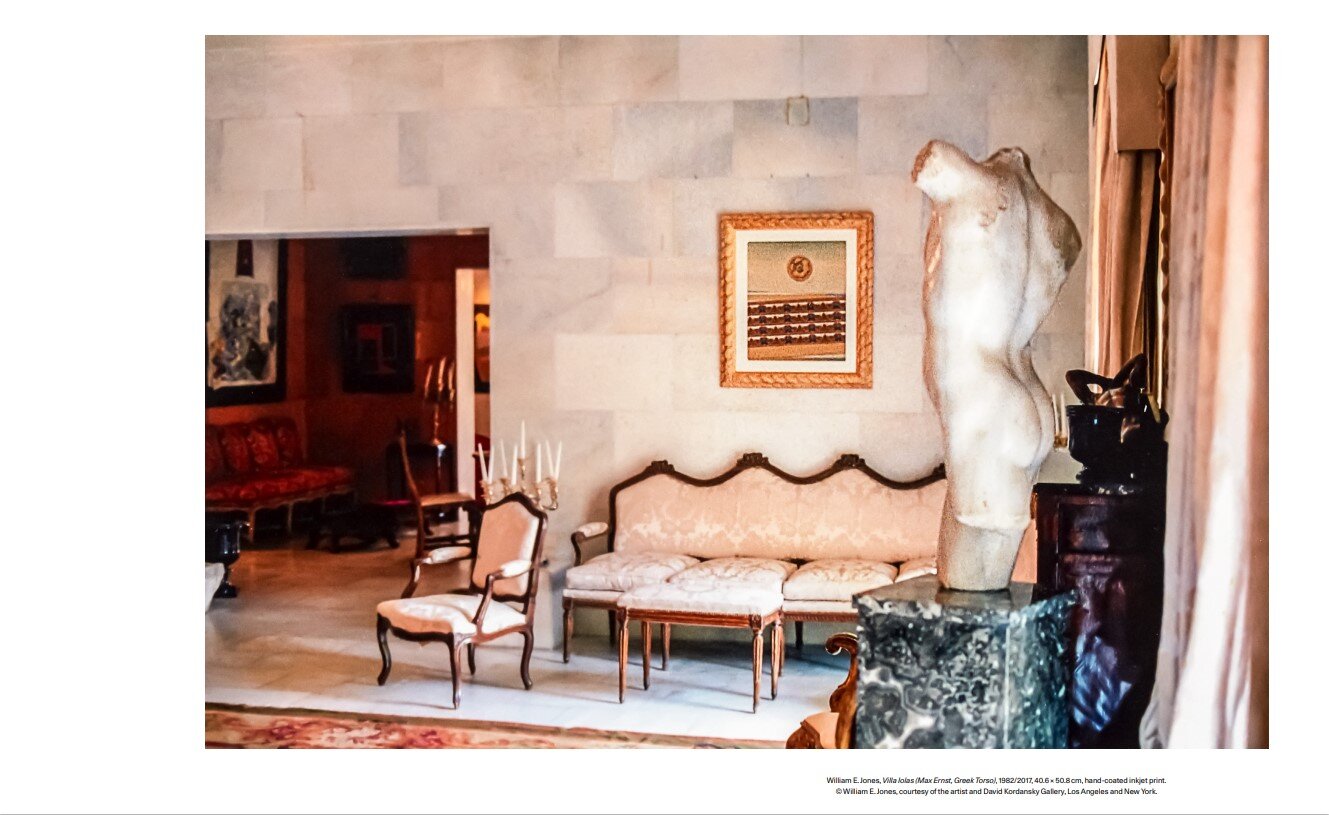
The whole family gathered at Villa Iolas during the summer months. Built in Agia Paraskevi, a middle-class suburb of Athens, the white marble mansion was a temple for Iolas's artists. There was a room dedicated to Warhol. The Lalannes had made the staircase's railings. Marina Karella's bronze furniture had a place of honour in the corridor, and one of Saint Phalle's Nanas was placed on the lawn. Once he gave Christiana Brandolini a tour. "At the end, Iolas said, 'You have to come and see the best thing I own,' and opened a wardrobe that had about 120 furs," she says. "Then he put one on. It was August." Katie Aga Khan remembers some ancient chairs he preserved under transparency.
"I said, 'Iolas, what's this?' And he replied, 'Don't sit on them, they're valuable.'"
"I had no intention, they were awful, but Iolas thought they were wonderful." Giancarlo Giammetti, Valentino's partner, flew to Athens to buy Fassianos works. "And again I adore him," he says, "but Mr. Iolas asked me to trade the value of the painting for clothes for his boys!" And this had begun to become an issue. The brilliant art dealer let his private life leak into his professional one. "Despite his exceptional achievements, my uncle couldn't be alone," says Eleni Koutsoudi-Iola. "And though he said, 'I'm not afraid to die,' of course he was." After Iolas closed most of his galleries and withdrew to Greece in 1983, the situation worsened. "Iolas was unrestrained," says Christopher Makos, who first met him with Warhol. "But there are many young men who like to have a 'father figure.' When they all know what the trade-off is, they learn things." Nevertheless, Iolas's intimates blame a young man named Adonis Nikoli, known for impersonations of Maria Callas. "Nikoli was so malicious," says Iolas's niece. "My uncle met him through one of his artists, Yannis Tsarouchis, and took him in when Yannis threw him out. He had caught Nikoli stealing. But he was very gifted at building wardrobes and making flower arrangements. Then Nikoli began stealing from Iolas. He started with slippers and moved on to serious pieces." Unfortunately, when Iolas threw him out, Nikoli gathered various Greek journalists and accused the art dealer of antiquities smuggling and paedophilia — telling a heap of lies. "They dragged Iolas's name through the mud in the Greek press," says Koutsoudi-Iola. "That's why I wrote my book, My Uncle Alexander Iolas: The Man Behind the Myth (2021). I wanted everyone to know the real story." Warhol also came to his defence. "He got into trouble and Andy signed a character letter," says Fremont. Rumours began to circulate that Iolas had HIV, but Mourgues disputes them, as does Fremont. "He had triple bypass surgery in New York," says Fremont. "A few days later, he was up and about. He had enormous energy for such an old person."
Bob Colacello visited Villa Iolas together with the art dealer Thomas Ammann in 1986, the summer before Iolas's death. "Guarded by a pair of Byzantine lions, it was the only palace on the block," says the writer. "We found Iolas lying on his deathbed, a gilded neo-Egyptian chaise longue. He wasn't really dying, he was just playacting, like Greta Garbo, to torment Brooks [Jackson] and André Mourgues, who had long been suffering. Both had been nursing him for weeks, waiting for him to decide who would get which Picasso." Meanwhile, a local transvestite contributed to the drama by dancing with veils around the patient's bed. "Dear Robertino," Iolas said breathlessly, "how kind of you to come all this way to see a dying man."
Alexander the Great mustered his strength for Warhol's last show, with drawings and paintings based on Leonardo da Vinci's Last Supper, at Milan's Palazzo. "It was very sweet of Iolas to come out of the hospital to meet me at the airport," Warhol writes in his memoirs. Christopher Makos described Iolas appearing "with the biggest scarf I have ever seen." "Iolas was grand and uncompromising," says Makos — even if Warhol thought the scarf made him look like a little old lady.
After Warhol's death, Iolas went to New York for treatment. "I went to see him in the hospital. He was very thin," says Marina Karella. "When I returned, no one was allowed to see him." Niki Stifel brought Iolas on one last trip to Greece. Their niece had to ask for a court order to see him. "He was in a terrible state, always making strange movements — almost like nervous spasms," says Eleni Koutsoudi-Iola. "I think it was a symptom of AIDS."
Nevertheless, when Iolas finally died on 8 June 1987, the American Hospital certificate stated the cause of death was sepsis. "He was old and had problems," says Mourgues. And in John Russell's obituary in The New York Times, only his sister, Niki, and her daughters are mentioned; and not at all Eleni Koutsoudi-Iola, his beloved niece, who concludes, "What a sad woman my aunt was. Nothing was ever enough."
The final tragedy was the looting of Villa Iolas. Initially there were plans to turn it into an art institute and give it to the Greek state. Instead, it was recklessly vandalised. All the walls were sprayed with paint and Iolas's incredible catalogues were brutally burned by local drug addicts as if in a funeral pyre. "It was a shocking massacre," says Koutsoudi-Iola. "I never wanted to return." But, as Iolas once said, "There is enough movement and madness in life that I don't understand why anyone would look to the past." Even so, we can easily imagine Iolas's eye continuing on in famous collections. "He was a guiding light and the most singular person," says Vincent Fremont. "There are many influential art dealers, but it is hard to find one so dazzling."